In the pre-Islamic era, the currencies circulating in the Arabian Peninsula were brought by commercial caravans, especially through the two main trading journeys of the Quraysh tribe to Syria and Yemen. These commercial trips are mentioned in the Holy Quran in Surat Quraysh:
“For the accustomed security of the Quraysh – their accustomed security (in) the caravan of winter and summer.” (Quran, Surah Quraysh, 106:1-2)
The primary coins used during this period were the Byzantine Dinar, made of gold and called “Eye,” and the Sassanid Persian Dirham, made of silver and referred to as “Al Wareq.” After the emergence of Islam in the Arabian Peninsula, Muslims initially did not mint their own coins. Prophet Muhammad (peace be upon him) acknowledged the use of Byzantine and Sassanid coins despite the fact that they carried symbols which contradicted the spirit of Islam.
The Two Types of Sassanid Dirhams
The silver Sassanid Dirhams used during the rise of Islam were of two main types:
- The Baghlya Dirhams, which were called “sufficient blacks” and weighed eight dawanik.
- The Tiberian Dirhams, called “ancient,” weighing four dawanik.
The difference in weight created difficulties in paying zakat and tribute, leading to an agreement that the Islamic legal weight of the dirham would be fixed at six dawanik, which is the average weight of the two types of dirhams. This change was attributed to Ali ibn Abi Talib (may Allah be pleased with him), who said that when the Prophet Muhammad (peace be upon him) married his daughter Fatimah (peace be upon her), the dowry was 480 dirhams, each weighing six dawanik.
The Caliphs and Currency Reform
Abu Bakr al-Siddiq (11-13 AH / 632-634 AD): After the death of the Prophet (peace be upon him), the first Caliph, Abu Bakr al-Siddiq (may Allah be pleased with him), continued the use of Byzantine and Sassanid coins without making any changes.
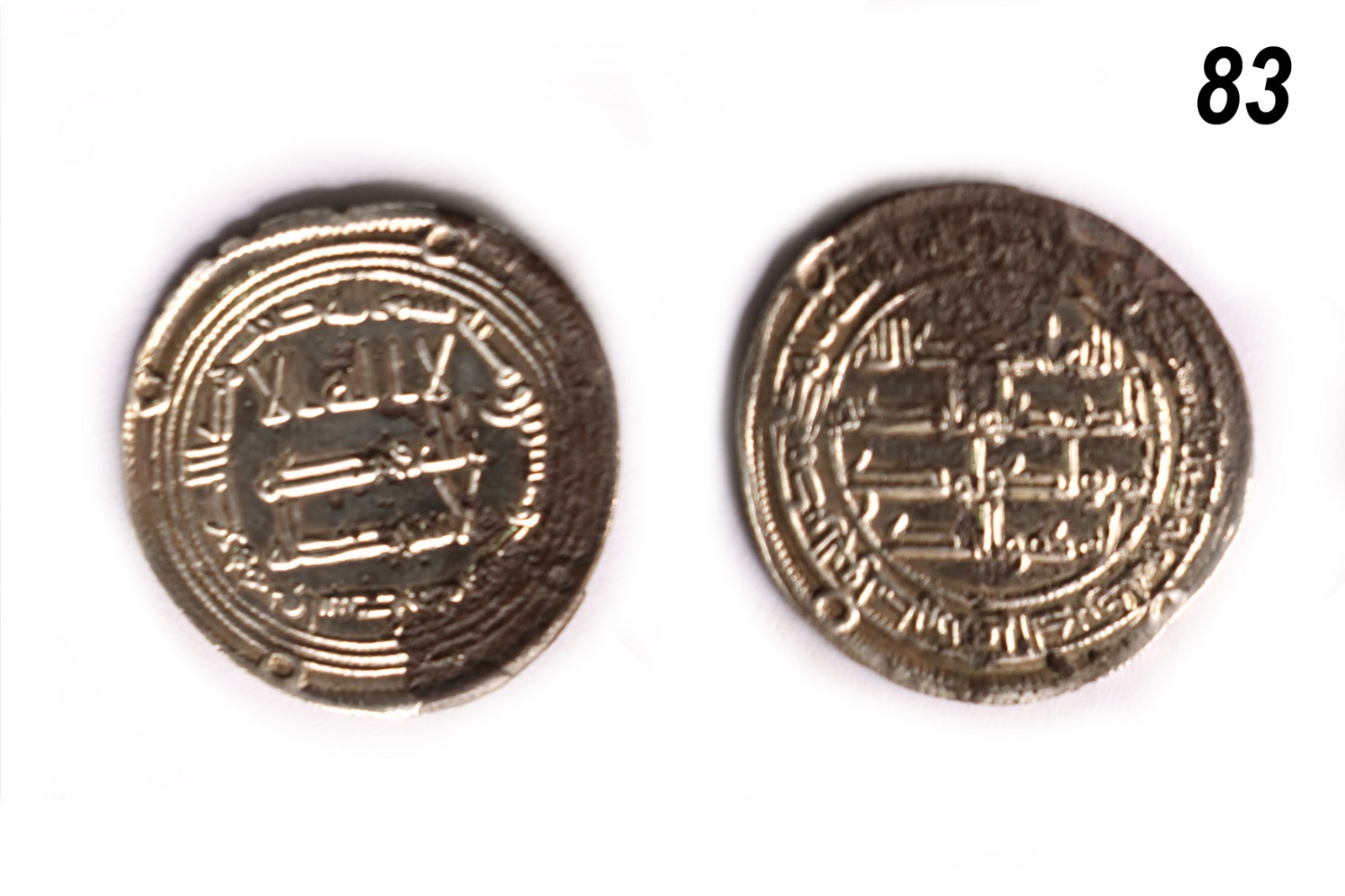
Umar ibn al-Khattab (13-23 AH / 634-644 AD): During the reign of the second Caliph, Umar ibn al-Khattab (may Allah be pleased with him), significant Islamic conquests took place, including the defeat of the Persians and the conquest of Egypt. Although the Byzantine and Sassanid currencies were still used, Umar ibn al-Khattab began adding Arabic inscriptions on silver coins starting from the year 18 AH. These inscriptions included phrases like “In the Name of Allah” and “Good.” This marked the first time Arabic words appeared on Sassanid coins.
Uthman ibn Affan (23-35 AH / 644-655 AD): During the time of the third Caliph, Uthman ibn Affan (may Allah be pleased with him), the spread of Islam continued, and Arabic inscriptions on coins became more prevalent. Phrases such as “In the Name of Allah, my Lord” and “In the Name of Allah, my King” were added.
Ali ibn Abi Talib (35-40 AH / 655-661 AD): The minting of coins continued in the Sassanid style, with additional Arabic phrases, including “The Advocate of Allah.”
The Establishment of the Umayyad Caliphate
Muawiya ibn Abi Sufyan (41 AH / 661 AD): The Umayyad Caliphate was established in 41 AH (661 AD), with Damascus as the capital. Caliph Muawiya paid much attention to minting coins, producing two types of silver dirhams. The first was similar to those of the Rightly Guided Caliphs, while the second type bore Fahlavi letters, signifying Muawiya as the “Emir of the Believers.” Muawiya is also said to be the first to mint gold dinars bearing his image holding a sword. However, these dinars are not found in records today.
Abdul-Malik ibn Marwan and the Reform of Coinage
Abdul-Malik ibn Marwan (65-86 AH / 684-705 AD): The fifth Umayyad Caliph, Abdul-Malik ibn Marwan, initiated significant monetary reform. Under his rule, coins were minted entirely in Arabic, independent of Byzantine and Sassanid models. This was part of a broader effort to unify the Islamic nation and Arabize all governmental institutions. Abdul-Malik fixed the weight of the gold dinar at 4.25 grams, and these coins were exclusively minted in the Mint House of Damascus, Syria, and Fustat, Egypt.
Egyptian Currency Under the Umayyads and Beyond
From the time of Abdul-Malik ibn Marwan, the Egyptian currency followed the dinar and dirham system. These coins, and their smaller denominations, the fils and half-fils, remained the standard currency through the Abbasid, Fatimid, Ayyubid, Bahari Mamluk, and Circassian Mamluk periods. The currency system changed only during the Ottoman conquest of Egypt under Sultan Selim I in 2 AH / 1517 AD, when the minting system was aligned with the Ottoman standards.