The Ghilaf-e-Kaaba, or Kiswah, holds immense spiritual and historical significance in the Islamic world. It is the sacred covering of the Kaaba, the holiest site in Islam, located in Masjid al-Haram in Makkah, Saudi Arabia. Muslims around the world revere this sacred structure, which symbolizes the unity and oneness of Allah. The Ghilaf is adorned with beautiful Quranic calligraphy, intricately embroidered using gold and silver threads, signifying devotion and the sacredness of the Kaaba.
Historical Origins of the Ghilaf
The tradition of covering the Kaaba dates back to the time of Prophet Ibrahim (Abraham, peace be upon him) and Prophet Ismail (Ishmael, peace be upon him) around 2000 BCE, when they built the Kaaba as a house of worship for Allah. Over centuries, different civilizations and Islamic rulers contributed to this sacred tradition. The practice gained more structure during the Abbasid Caliphate, where the standard black silk covering with Quranic verses became a norm. Every ruler would ensure that the Kaaba was adorned with a new Kiswah, showcasing their respect for this divine house.
Modern Developments in Kiswah Production
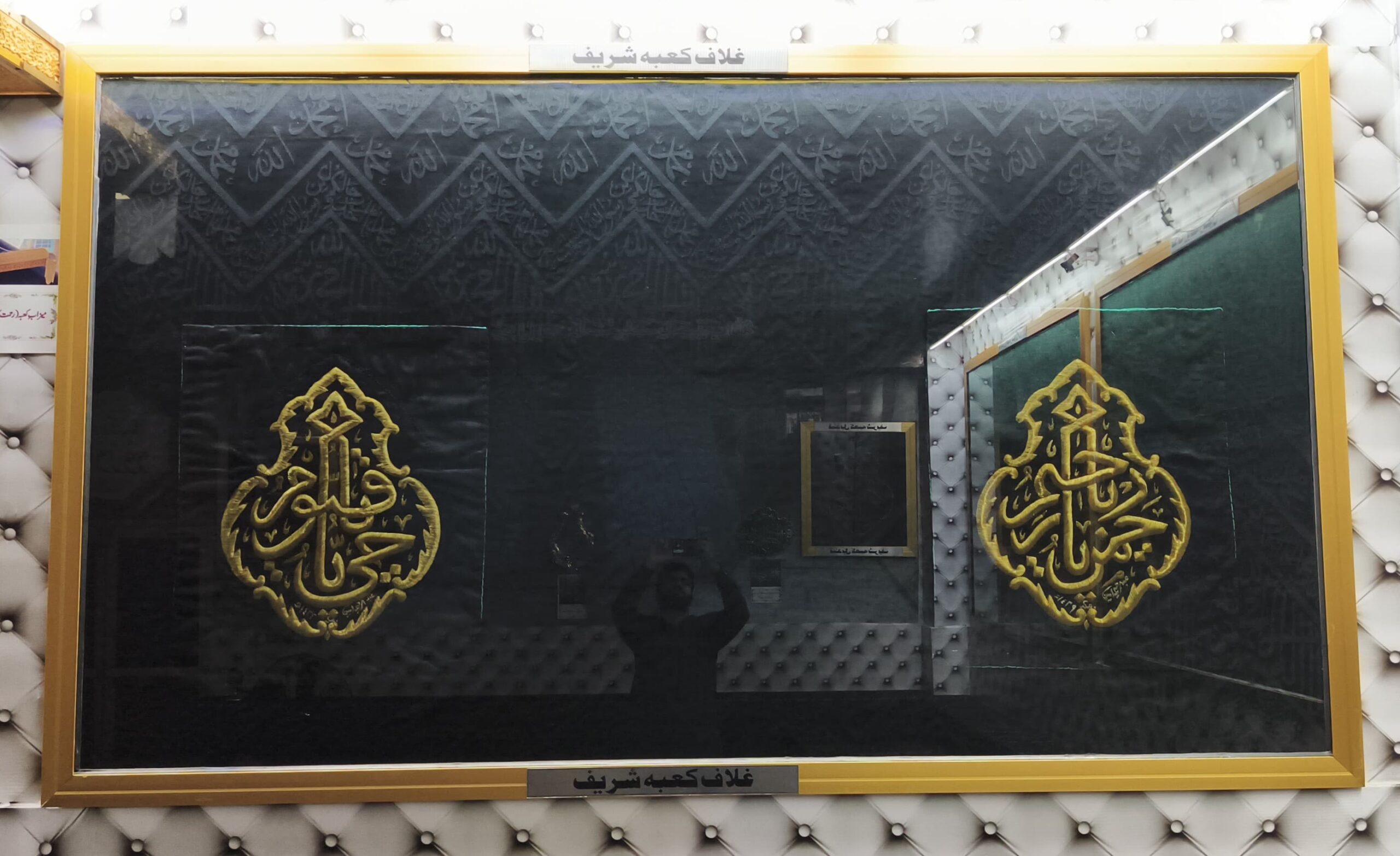
In the 20th century, King Abdulaziz Al Saud of Saudi Arabia institutionalized the production of the Ghilaf by establishing a dedicated factory in Makkah in 1927 CE. This factory has continued to produce the Kiswah annually using state-of-the-art technology and skilled artisans. Over 670 kilograms of pure silk and 120 kilograms of gold and silver threads are used to craft the Ghilaf. The Quranic verses are embroidered with precision and care, ensuring the highest level of artistry. Each piece of the Kiswah, such as the one inscribed with “Ya Rahman Ya Raheem” in 1429 Hijri (2008 CE), reflects Islamic devotion and craftsmanship.
The Annual Replacement Ceremony
The Kiswah is ceremonially replaced every year on the 9th of Dhul-Hijjah, a day before Eid al-Adha and during the Hajj pilgrimage. This sacred ceremony is performed with immense reverence. The new Ghilaf is draped over the Kaaba, and the old one is carefully removed. Pieces of the old Ghilaf, like the section embroidered with “Ya Rahman Ya Raheem,” are distributed to Muslim dignitaries, scholars, and Islamic institutions across the globe. These pieces serve as cherished tokens of faith and blessings.
The Symbolism of “Ya Rahman Ya Raheem”
The phrase “Ya Rahman Ya Raheem,” meaning “O Most Merciful, O Most Compassionate,” is a testament to Allah’s infinite mercy and compassion. This phrase, prominently featured on the Ghilaf-e-Kaaba, is a reminder of Allah’s attributes. The piece of the Ghilaf inscribed with this sacred text from 1429 Hijri embodies the timeless spiritual connection Muslims have with the Creator. Such phrases, carefully woven into the fabric, not only beautify the Kaaba but also inspire millions of pilgrims who visit the holy site.
The Symbolism of “Ya Hayyu Ya Qayyum”
The phrase “Ya Hayyu Ya Qayyum”, meaning “O Ever-Living, O Sustainer of Existence,” is a powerful invocation of Allah’s eternal life and His sustaining power over all creation. It signifies the divine attributes of Allah, emphasizing His infinite life and sovereignty over the universe. This phrase, often recited by Muslims in times of need, represents the belief that Allah alone is the source of life and sustenance for all living beings.
The inscription of “Ya Hayyu Ya Qayyum” on the Ghilaf-e-Kaaba serves as a profound reminder to millions of pilgrims who visit the holy site. This sacred text, woven into the fabric of the Ghilaf, is a symbol of the timeless spiritual bond between Muslims and Allah. The year of inscription, 1429 Hijri, marks the continuity of this tradition, demonstrating how these divine attributes remain central to Islamic faith and practice.
The inclusion of this phrase on the Ghilaf not only enhances the beauty of the Kaaba but also deepens the spiritual experience for those who encounter it. Pilgrims, upon seeing these words, are reminded of Allah’s eternal presence and His ultimate control over the world. It serves as a call to turn to Allah for guidance, sustenance, and support in all aspects of life.
The phrase “Ya Hayyu Ya Qayyum” also represents a call to reflect on the impermanence of life. As the Ever-Living and Sustainer, Allah is the only constant in an ever-changing world. It inspires believers to place their trust in Allah’s eternal power and to seek His mercy and guidance in every moment of their lives.
Conclusion: The Eternal Significance of the Ghilaf
The Ghilaf-e-Kaaba is not merely a covering; it is a symbol of Islamic unity, devotion, and craftsmanship. Over centuries, this sacred cloth has stood as a testament to the unshakable faith of Muslims worldwide. The tradition of crafting and adorning the Kaaba with the Kiswah continues to bring Muslims closer to Allah, reminding them of His mercy and guidance. Pieces of the Ghilaf, like the one with “Ya Rahman Ya Raheem,” carry the legacy of this sacred practice and hold profound meaning for Muslims everywhere.