In 168 B.C., Antiochus IV ordered the Jews to worship Greek gods. The Temple in Jerusalem was seized and dedicated to Zeus. The Jews revolted and after three years of fighting, Judah Maccabee defeated the Seleukid army. Hanukkah, the Festival of Lights, commemorates the rededication of the Temple in 165 B.C. According to the Talmud, there was only enough consecrated olive oil to fuel the eternal flame in the Temple for one day. Miraculously, the oil burned for eight days, enough time to prepare and consecrate fresh oil.
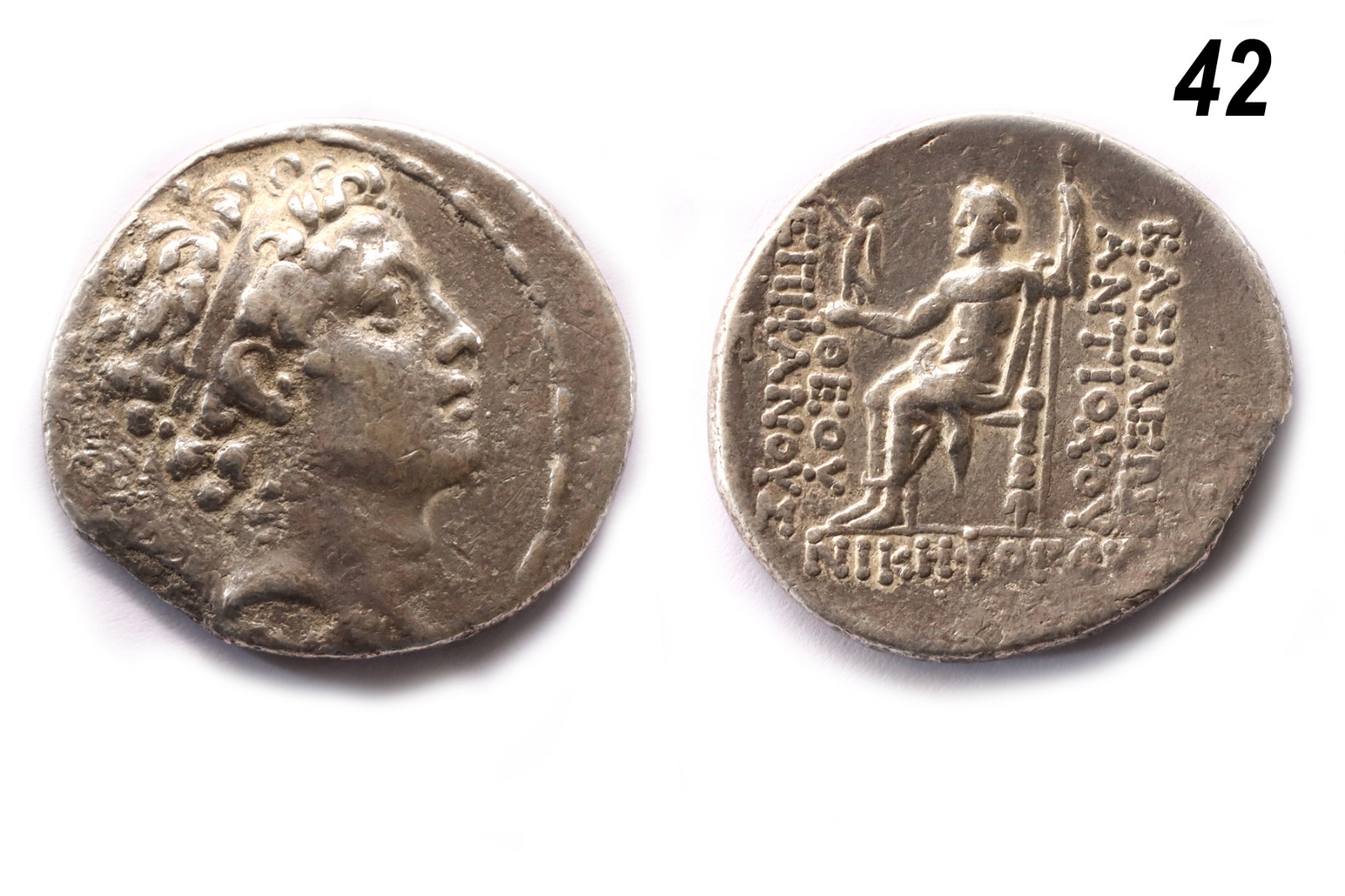
Antiochos IV assumed divine epithets, which no other Hellenistic king had done before, such as Theos Epiphanes (“God Manifest”). His subjects made a pun on his name, calling him Epimanes (madman).
GY95970. Silver tetradrachm, Houghton-Lorber II 1396(a), SNG Spaer 973 var. (no control), Houghton CSE 99 var. (same), Newell SMA 54 var. (same), HGC 9 619, VF, superb portrait and depiction of Zeus, toned, bumps, marks, struck with a dirty reverse die, minor flan flaw below chin, Antioch (Antakya, Turkey) mint, weight 16.403g, maximum diameter 31.0mm, die axis 0o, 173/2 – 169/8 B.C.; obverse diademed head of Antiochos IV right, diadem ends with stars (off flan), fillet border; reverse BAΣIΛEΩΣ/ ANTIOXOY downward on right, ΘEOY / EΠIΦANOYΣ downward on left, Zeus enthroned left, nude to the waist, himation around hips and legs, Nike bearing wreath in right hand, scepter vertical in left hand, both uprights of throne back seen, (control) in exergue; from the Errett Bishop Collection;
REFERENCES
Babelon, E. Les Rois de Syrie, d’Arménie, et de Commagène. Catlogue de monnaies grecques de la Bibliothèque Nacionale. (Paris, 1890).
Brett, A. “Mint of Ascalon under the Seleucids” in ANSMN IV. (New York, 1950). Brett, A. “Seleucid Coins of Ake-Ptolemais in Phoenicia, Seleucus IV to Tryphon” in ANSMN 1 (New York, 1945).
Cohen, E. Dated Coins of Antiquity: A comprehensive catalogue of the coins and how their numbers came about. (Lancaster, PA, 2011).
Gardner, P. Catalogue of Greek Coins in the British Museum, The Seleucid Kings of Syria. (Forni reprint, 1963).
Hill, G. Catalogue of Greek Coins in the British Museum: Phoenicia. (London, 1910).
Hoover, O. Coins of the Seleucid Empire from the Collection of Arthur Houghton, Part II. ACNAC 9. (New York, 2007).
Hoover, O. Handbook of Syrian Coins, Royal and Civic Issues, Fourth to First Centuries BC. HGCS 9. (Lancaster, PA, 2009).
Houghton, A., C. Lorber, & O. Hoover. Seleucid Coins: A Comprehensive Catalog. (Lancaster, 2002 – 2008).
Houghton, A. Coins of the Seleucid Empire from the Collection of Arthur Houghton. ACNAC 4. (New York, 1983).
Houghton, A. “The Second Reign of Demetrius II of Syria at Tarsus” in ANSMN 24 (1979).
Imhoof-Blumer, F. “Die Münzstätte Babylon, etc.” in Num. Zeit., 1895, pp. 1 ff.
Kritt, B. Seleucid Coins of Bactria. CNS 1. (Lancaster, 1996).
Kritt, B. The Seleucid Mint of Aï Khanoum, CNS 9. (Lancaster, PA, 2016).
Le Rider, G. Antioche de Syrie sous les Séleucides, I: De Seleucos I à Antiochos V. (Paris, 1999).
Le Rider, G. Suse Sous les Séleucides et Les Parthes, Les Trouvailles Monétaires et l ‘Histoire de la Ville. (Paris, 1965).
Levante, E. Sylloge Nummorum Graecorum Switzerland I. Levante-Cilicia. (1986, and supplement).
Lindgren, H. & F. Kovacs. Ancient Bronze Coins of Asia Minor and the Levant. (1985).
Lindgren, H. Lindgren III: Ancient Greek Bronze Coins from the Lindgren Collection. (1993).
Lorber, C. “The Lotus of Aphrodite on Ptolemaic Bronzes” in SNR 80 (2001).
Macdonald, G. Catalogue of Greek Coins in the Hunterian Collection, University of Glasgow, Vol. III. (Glasgow, 1905).
Macdonald, G. “Early Seleucid Portraits” in Journal Hellenistic Studies, 1903, pp. 92 ff., and 1907, pp. 145 ff.
Nelson, B. “The 2005 ‘Seleucus I’ Hoard” in Coin Hoards X (2010).
Newell, E. Late Seleucid Mints in Ake-Ptolemais and Damascus. ANSNNM 84 (New York, 1939).
Newell, E. Seleucid Coins of Tyre: A Supplement. ANSNNM 73 (New York, 1936).
Newell, E. The Coinage of the Eastern Seleucid Mints. From Seleucus I to Antiochus III. (New York, 1938).
Newell, E. The Coinage of the Western Seleucid Mints, From Seleucus I to Antiochus III. (New York, 1941).
Newell, E. The Seleucid Mint of Antioch. (Chicago, 1978).
Price, M. The Coinage of in the Name of Alexander the Great and Philip Arrhidaeus. (London, 1991).
Rogers, E. The Second and Third Seleucid Coinage at Tyre. ANSNNM 34 (New York, 1927).
Saulcy, F. de. Numismatique de la Terre Sainte : description des monnaies autonomes et impériales de la Palestine et de l’Arabie Pétrée. (Paris, 1874).
Sear, D. Greek Coins and Their Values, Volume 2, Asia and Africa. (London, 1979).
Sylloge Nummorum Graecorum, Denmark, The Royal Collection of Coins and Medals, Danish National Museum, Vol. 7: Cyprus to India. (West Milford, NJ, 1982).
Sylloge Nummorum Graecorum, France, Cabinet des Médailles, Bibliothéque Nationale. (Paris, 1993 – 2001).
Sylloge Nummorum Graecorum, Greece, Volume IV, Numismatic Museum, Athens, The Petros Z. Saroglos Collection, Part| 1: Macedonia. (Athens, 2005).
Sylloge Nummorum Graecorum, Israel I, The Arnold Spaer Collection of Seleucid Coins. (London, 1998).
Sylloge Nummorum Graecorum Switzerland I. Levante-Cilicia. (Zurich, 1986; & suppl., 1993).
Taylor, L. “From Triparadeisos to Ipsos: Seleukos I Nikator’s Uncertain Mint 6A in Babylonia” in AJN 27 (2015).